


Effects of Different Silicate Concentrations on Growth Performance of Thalassiosira sp. as Live Feed for Shrimp Larvae
Main Article Content
Andri Hendriana
Imam Tri Wahyudi
Sheny Permatasari
Background: Diatoms require silicate for frustule formation and optimal cell division, making silicate availability a critical factor in improving microalgal production for aquaculture. Thalassiosira sp. is one of the most widely used live feeds in shrimp hatcheries because of its high nutritional value and suitable cell size for larval consumption.
Aims: This study evaluated the effects of different silicate concentrations on the growth performance of Thalassiosira sp. by simultaneously assessing cell density, specific growth rate (SGR), and division rate (DR).
Methods: A completely randomized design with four treatments was employed: control (without silicate), 15 ppm (SL15), 20 ppm (SL20), and 25 ppm (SL25), each with three replicates. Cell density was monitored daily for 14 days using a haemocytometer, while SGR and DR were calculated from the exponential growth model.
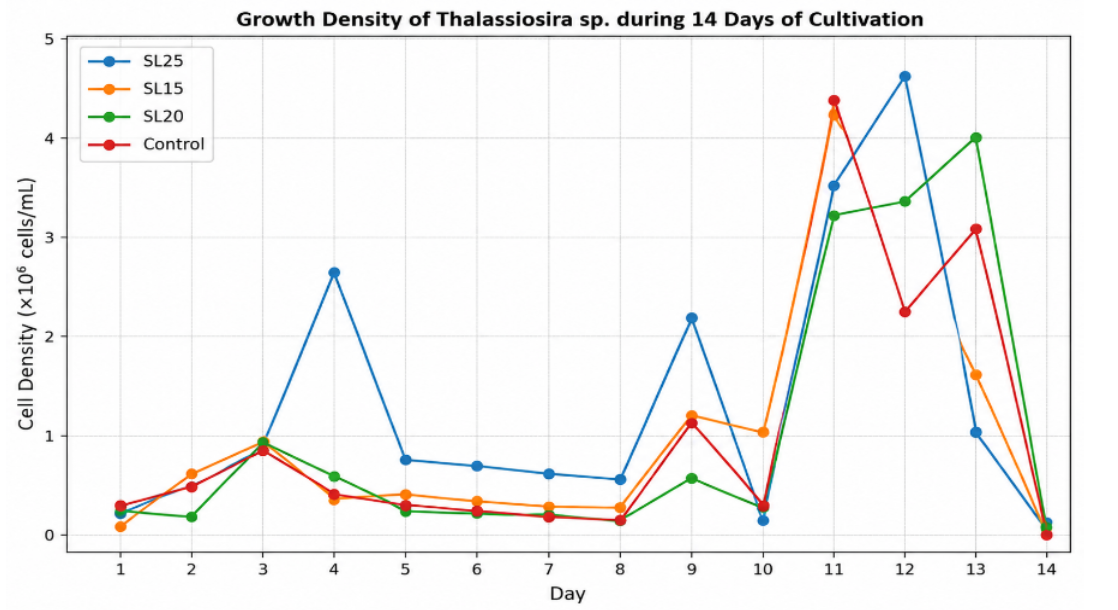
Results: The results showed that silicate supplementation significantly affected all growth parameters (p < 0.05). The highest cell density (4.60 × 10⁶ cells mL⁻¹) was obtained in the SL25 treatment on day 12, whereas the highest SGR (29.17 ± 0.32% day⁻¹) and DR (0.422 ± 0.005 divisions day⁻¹) were recorded in SL20. However, Duncan's Multiple Range Test indicated no significant differences between SL20 and SL25 for SGR and DR, suggesting comparable physiological responses at these silicate concentrations. These findings indicate that silicate concentrations between 20 and 25 ppm provide the optimal range for enhancing the growth performance of Thalassiosira sp. and may improve the efficiency of live-feed production for shrimp hatchery applications.
Conclusion: Silicate supplementation significantly improve the growth performance of Thalassiosira sp., as reflected by increased cell density, specific growth rate, and division rate.
Afianti, S., & Endrawati, H. (2024). The Influence of Differences in Silicate Concentration on The Growth of Microalgae Thalassiosira sp. at The Laboratory Scale. Journal of Marine Biotechnology and Immunology, 2(1), 10-14.
Aisyah, N., Kusyairi, A., & Sumaryam, S. (2024). Pengaruh pemberian pupuk silika dengan vitamin B12 terhadap kepadatan Thalassiosira sp. pada skala laboratorium. Jurnal Pendidikan Tambusai, 8(2), 30708–30716.
Arifin, N. B., Febiana, A., Supriatin, F. E., & Fakhri, M. (2025). Growth, biomass, and pigment content of Thallassiosira sp. cultivated under different medium. Jurnal Sumberdaya Akuatik Indopasifik, 9(1), 51–66. https://doi.org/10.46252/jsai-fpik-unipa.2025.Vol.9.No.1.494
Benoiston, A. S., Ibarbalz, F. M., Bittner, L., Guidi, L., Jahn, O., Dutkiewicz, S & Bowler C. (2017). The Evolution of Diatoms and Their Biogeochemical Functions. Philos Trans R Soc Lond B Biol Sci, 372(1728), 20160397. https://doi.org/10.1098/rstb.2016.0397
Boyd, P. W., Rynearson, T. A., Armstrong, E. A., Fu, F., Hayashi, K., Hu, Z., Hutchins D. D., Kudela, R. M., Litchman, E., Mulholland, M. R., Passow, U., Strzepek, R. F., Whittaker, K. A., Yu, E., & Thomas, M. K. (2013). Marine phytoplankton temperature versus growth responses from polar to tropical waters – outcome of a scientific community-wide study. Plos One, 8, 1-17.
Cannavaro, S. V., Endrawati, H., & Setyati, W. A. (2024). Analisis kandungan klorofil-a dan kepadatan diatom Thalassiosira sp. dengan penggunaan konsentrasi silikat yang berbeda. Journal of Marine Research, 13(1). DOI: https://doi.org/10.14710/jmr.v13i1.35303
Costard, G. S., Machado, R. R., Barbarino, E., Martino, R. C., & Lourenço. (2012). Chemical Composition of Five Marine Microalgae that Occur on The Brazilian Coast. International Journal of Fisheries and Aquaculture, 4(9), 191-201.
Devianti, D., Narayana, Y., & Amrullah, A. (2022). Penggunaan Pakan alami Chlorella sp. dan Thalassiosira sp. untuk mempercepat perkembangan dan meningkatkan sintasan larva udang vaname (Litopenaeus vannamei) pada Stadia Zoea sampai Mysis. Agrokompleks, 2(2), 1-6.
Dewi, R. (2017). Produktivitas minyak dan kandungan asam lemak Thalassiosira sp. yang dikultivasi dengan makronutrien pupuk. Edu Chemia. Jurnal Kimia dan Pendidikan, 2(2), 221-235.
Erlangga, E., Andira, A., Erniati, E., Mahdaliana, M., & Muliani, M. (2021). Increased density of Thalassiosira sp with different doses of silicate fertilizer. Acta Aquatica: Aquatic Sciences Journal, 8(3), 167-174.
Fakhri, M., Arifin, N. B., Hariati, A. M., & Yuniarti, A. (2017). Growth, Biomass, and Chlorophyll-a and Carotenoid Content of Nannochloropsis sp. Strain BJ17 Under Different Light Intensities. Jurnal Akuakultur Indonesia, 16(1), 15-21.
FAO. (2020). The state of world fisheries and aquaculture 2020. Food and Agriculture Organization of The United Nations.
Garcia, N., López-Elías, J. A., Miranda, A., Martínez-Porchas, M., Huerta, N., & García, A. (2012). Effect of salinity on growth and chemical composition of the diatom Thalassiosira weissflogii at three culture phases. Latin American Journal of Aquatic Research, 40(2), 435-440. DOI: 10.3856/vol40- issue2-fulltext-18
Han, F., Wang, W., Li, Y., Shen, G., Wan, M., Wang, J. (2013). Changes of biomass, lipid content and fatty acids composition under a light–dark cyclic culture of Chlorella pyrenoidosa in response to different temperature. Bioresour Technol, 132, 182–9.
Hildebrand, M. (2008). Diatoms, biomineralization processes, and genomics. Chem Rev, 108(11), 4855-4874. doi: 10.1021/cr078253z.
Jessica, J., Kurniawan, A., & Akbar, M. Y. (2024). Teknik Kultur Fitoplankton Thalassiosira sp. Skala Laboratorium Di PT. Central Proteina Prima, Lubuk Besar, Bangka Tengah. Amreta Meena, 1(3), 120-126.
Kurniaji, A., Wahid, E., Regan, Y., Rasnijal, M., & Normayanti, N. (2025). Pertumbuhan Diatom Thalassiosira sp. Dan Chaetoceros sp. Pada Skala Laboratorium, Intermediate Dan Massal. Authentic Research of Global Fisheries Application Journal, 7(2), 267-278
Marthia, N. (2020). Pengaruh jenis media kultur terhadap konsentrasi biomassa Nannochloropsis sp. Pasundan Food Technology Journal (PFTJ), 7(3), 97-101.
Martin-Jézéquel, V., Hildebrand, M., & Brzezinski, M. A. (2000). Silicon metabolism in diatoms: implications for growth. Journal of Phycology, 36(5), 821–840.
Muhklis, A., Abidin, Z., & Rahman, I. (2017). Pengaruh konsentrasi pupuk ammonium sulfat terhadap pertumbuhan populasi sel Thalassiosira sp. Biowallacea Jurnal Ilmiah Ilmu Biologi, 3(3), 149-155.
Nur, A., Widyany, D. A., & Ruliaty, L. (2017). Manajemen Pakan pada Produksi Benih Udang Jerbung Penaeus merguiensis. Jurnal Perekayasaan Akuakultur Indonesia, 1(1), 43-56.
Nurfalaa, N., Rosyida, E., & Ya'la, Z. R. (2016). Pengaruh Fotoperiod Terhadap Kepadatan Sceletonema costatum Skala Laboratorium. Jurnal AgriSains, 17(3), 153-159.
Panjaitan, A. S., Hadie, W., & Harijati, S. (2015). Penggunaan Chaetoceros Calcitrans, Thalassiosira weissflogii dan kombinasinya pada pemeliharaan larva udang vaname (Litopenaeus vannamei, Boone 1931). Jurnal Berita Biologi, 14(3), 235–240.
Nurul, S. K. (2023). Pengaruh intensitas cahaya yang berbeda terhadap kualitas Thalassiosira sp. sebagai pakan larva udang vaname (Litopenaeus vannamei). Universitas Hasanuddin. Fakultas Ilmu Kelautan dan Perikanan. Thesis.
Padang, A. (2014). Pertumbuhan fitoplankton Cocolithophote sp. di wadah terkontrol dengan kepadatan inokulum yang berbeda. Jurnal Ilmiah Agribisnis dan Perikanan, 6(3), 33-38.
Petrenko, S., & Page, K. M. (2025). Modelling the impact of organic molecules and phosphate ions on biosilica pattern formation in diatoms. Math Biosci, 387, 109484. doi: 10.1016/j.mbs.2025.109484.
Riski, R., Cinnawara, H. T., Patahiruddin, P., & Muchlis, A. M. (2021). Pengaruh Pemberian Dosis Pupuk Silikat yang Berbeda terhadap Kepadatan Thallasiosira sp. Fisheries of Wallacea Journal, 2(2), 93–99.
Sanjaya, F., & Danakusumah, E. (2018). Evaluasi kerja pertumbuhan diatom (Thalassiosira sp.) yang diberi dosis silikat. Jurnal Ilmiah Satya Minabahari, 1(1), 16-27.
Sas, A. A. A., Arshad, A., Das, S. K., Pau, S. S. N., & Cob, Z. C. (2023). Optimum temperature and salinity conditions for growth, lipid contents, and fatty acids composition of centric diatoms Chaetoceros calcitrans and Thalassiosira weissflogii. Pertanika Journal of Science and Technology, 31(2), 689–707.
Stenger-Kovács, C., Béres, V. B., Buczkó, K., Al-Imari, J. T., Lázár, D., Padisák, J., & Lengyel, E. (2023). Review of phenotypic response of diatoms to salinization with biotechnological relevance. Hydrobiologia, 850(1), 1-24. https://doi.org/10.1007/s10750- 023-05194-7
Torzillo, G., & Vonshak, A. (2004). Handbook of microalgal culture: Applied phycology and biotechnology, Second edition. Blackwell Publishing.
Umiatun, S., Carmudi, C., & Christiani, C. (2017). Hubungan antara kandungan silika dengan kelimpahan diatom bentik di sepanjang Sungai Pelus Kabupaten Banyumas. Scripta Biologica, 4(1), 61–67.
Utami, N. P., Suherman, Y. M., & Haetami, K. (2012). Pertumbuhan Chlorella sp. yang dikultur pada perioditas cahaya yang berbeda. Jurnal Perikanan dan Kelautan, 3(3), 237-243.
Vega, B. O. A., Lorenzo, S. L., & Ruiz, J. L. (2004). Effect of Zeolitic Products in the Nutritive Quality of the Diatom Thalassiosira weissflogii. Hidrobiológica, 14(1), 69-74.
Wahyudi, Chilmawati, D., Samidjan, I., & Suminto. (2022). Pengaruh Rasio Chelator dan Metal pada Media Kultur terhadap Pola Pertumbuhan dan Kandungan Protein Sel Diatom Thalassiosira sp. Jurnal Sains dan Akuakultur Tropis, 6(1), 129–137.
Xu H, Chen F, Luo M, Zhang X, Pan K, & Liu H. (2025). Silicon limitation affects diatom’s resistance to copepod grazing. Journal of Ocenology and Limnology, 43, 1201–1212. DOI:10.1007/s00343-024-4142-5muk
Andri Hendriana , Technology and Management of Applied Aquaculture, School of Vocational Studies, IPB University, Indonesia
INDONESIA
Imam Tri Wahyudi , Technology and Management of Applied Aquaculture, School of Vocational Studies, IPB University, Indonesia
INDONESIA
Sheny Permatasari , Technology and Management of Applied Aquaculture, School of Vocational Studies, IPB University, Indonesia
INDONESIA